What You’ll Learn
- Choosing the Right Crack Filling Equipment for Pavement Maintenance
- Why the Right Crack Filling Equipment Improves Long-Term Results
- The Purpose of Crack Filling and Sealing
- Financial Benefits of Early Crack Filling
- Understanding Crack Filling Equipment Categories
- When to Use Cold-Pour Crack Filling Equipment
- When to Use Hot-Pour Crack Filling Equipment
- Choosing Crack Filling Equipment for Your Next Project
- Learn More About Selecting the Right Equipment
- SealMaster Expertise & Support
Choosing the Right Crack Filling Equipment for Pavement Maintenance
Crack sealing is an integral component of an effective pavement preservation program. A scheduled pavement maintenance plan that includes sealcoating and crack filling, supported by properly selected crack filling equipment, can more than double the life cycle of asphalt pavement while maintaining curb appeal. Sealcoating and crack filling represent a fraction of the cost of repairing or replacing asphalt pavement.
The key to effective crack filling and sealing is addressing cracks while they are still small. Using the right crack filling equipment allows material to be placed efficiently and consistently, helping to inhibit crack growth and reduce the formation of new cracks. Crack sealing also provides superior protection against moisture intrusion, which is the leading cause of pavement failure.
Why the Right Crack Filling Equipment Improves Long-Term Results
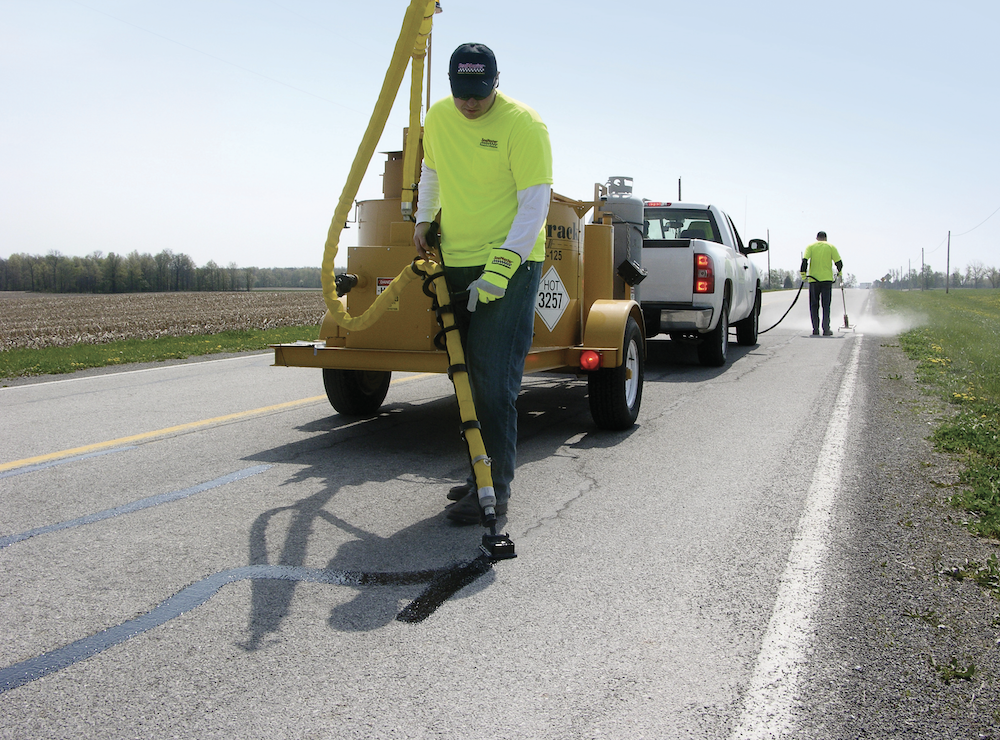
While crack filling is essential to pavement preservation, the results depend heavily on how the work is performed. Crack filling equipment plays a critical role in material placement, temperature control and overall repair consistency.
Equipment that is properly matched to the application helps ensure crack sealants are applied at the correct temperature and depth, improving adhesion and long-term performance. Inconsistent material flow or poor temperature control can reduce flexibility, lead to premature failure and increase material waste.
Crack filling equipment also directly impacts productivity and cost efficiency. Machines designed for the appropriate production level allow crews to work faster, reduce labor demands and achieve a lower cost per linear foot. Selecting the right equipment helps contractors complete work more efficiently while delivering repairs that better protect pavement from moisture intrusion and base erosion.
The Purpose of Crack Filling and Sealing
Crack filling helps protect asphalt pavement from two primary sources of damage: base erosion and ultraviolet exposure.
Base erosion occurs when water infiltrates cracks and weakens the pavement foundation. As the base settles and loses integrity, cracks form and multiply. Sealing cracks early diverts water away from the base. Instead, it allows the water to run off the berm, which helps to preserve the stability of the base.
Ultraviolet exposure from the sun accelerates pavement deterioration once cracks form. Ultraviolet rays from the sun then cause more damage during the expansion of the crack. Crack filling blocks UV exposure from reaching the inside of the crack and slows this process.
Financial Benefits of Early Crack Filling
Addressing cracks early is one of the most cost-effective strategies for pavement maintenance. Studies have shown that for every dollar spent on crack sealing, property owners and municipalities can save up to six dollars in future pavement repairs and restoration.
Typical crack filling costs range from approximately $0.35 to $1.00 per linear foot, depending on materials and application methods used.
Several factors affect the overall cost of crack filling, including:
- Size of the project measured in linear feet of cracking
- Severity and width of the cracks
- Surface preparation requirements, such as blowing out cracks or mechanical routing
- Type of crack filler used (Cold-Pour vs. Hot-Pour)
- Geographic location and regional labor costs
Understanding Crack Filling Equipment Categories
Crack filling equipment is designed to apply either cold-applied or hot-applied crack sealing materials. The right equipment depends on crack conditions, material selection, production needs and crew size.
When to Use Cold-Pour Crack Filling Equipment
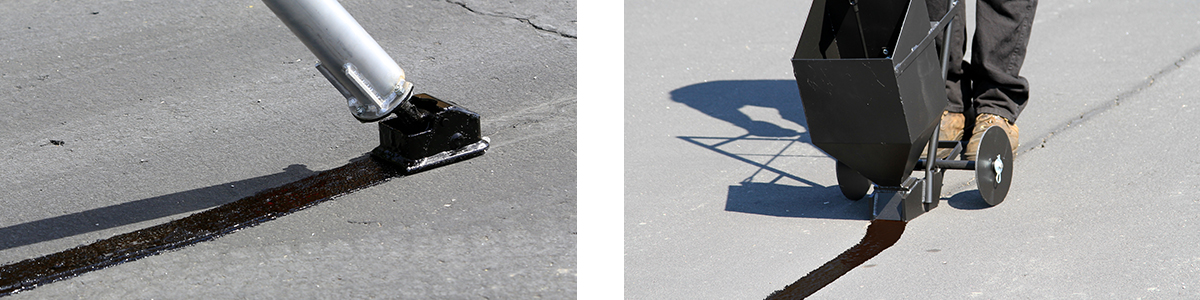
Cold-pour crack filling provides an efficient and economical approach to filling cracks in asphalt pavement. Cold-applied crack fillers typically consist of polymer-modified asphalt emulsions that flow into cracks at ambient temperatures.
Cold-applied crack filling is commonly performed on parking lots, driveways, walkways and other pavements with low to moderate traffic. These materials are typically used for cracks up to one inch wide. For cracks up to one-half inch, standard pourable crack filler is often sufficient. Wider cracks may require trowel-grade materials or specialty repair products, depending on traffic and movement.
When using cold-applied crack fillers, both ambient and pavement surface temperatures should remain above 50 degrees for a minimum of 24 hours.
Key Features to Consider
- Pump type and pressure consistency
- Hose length and wand control
- Ability to draw material from pails or drums
- Strainers or filters to reduce clogging
Cold-pour equipment offers portability and ease of use, making it well-suited for routine maintenance and crack repair projects of any size.
SealMaster Cold-Pour Crack Filling Equipment
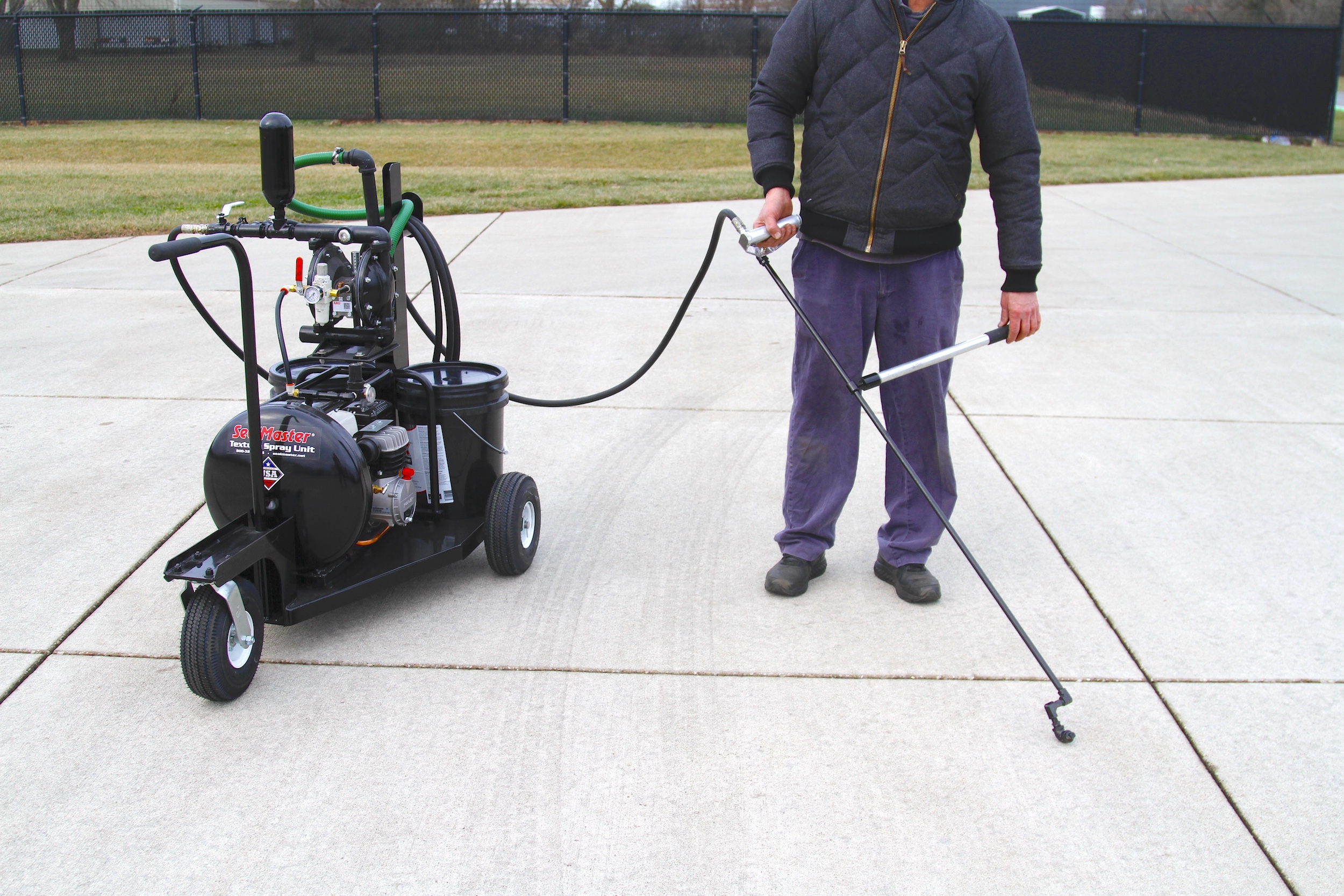
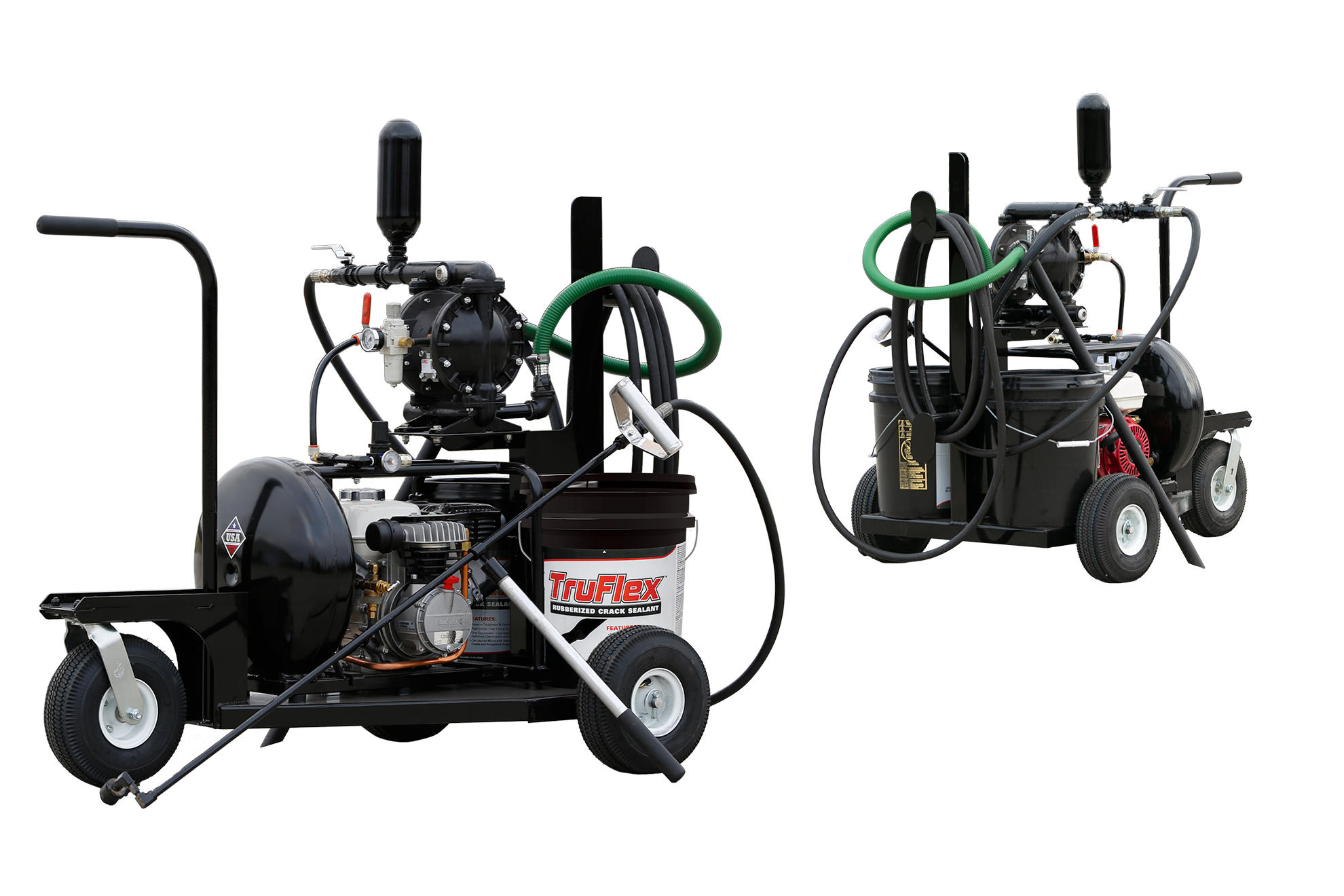
The SealMaster CrackPro 2500 Cold-Pour Application Unit is designed for efficient, controlled application of cold-applied crack fillers in asphalt pavement maintenance. This compact, wheel-mounted unit delivers consistent material flow for precise crack filling while allowing operators to move easily across the jobsite.
The CrackPro 2500 is engineered to support routine crack repair before sealcoating, helping limit moisture intrusion and slow pavement deterioration when cracks are addressed early.
SealMaster CrackPro 2500
Best suited for:
Cold-applied crack filling on parking lots, driveways and roads.
Key features include:
- Gas-powered engine supplying reliable power to both the compressor and pumping system for steady operation
- Integrated air compressor delivering consistent pressure to the air-diaphragm material pump for smooth, uninterrupted material flow
- Filtered suction system designed to help prevent debris from entering the pump and protect internal components
- 25-ft hose for extended reach and reduced repositioning during application
- Dual-pail capacity holding two 5-gallon pails to minimize downtime on larger crack repair projects
- Swivel wheel steering for improved maneuverability around curbs, parking blocks and tight pavement areas
- Ergonomically adjustable application wand to help reduce operator fatigue and maintain application consistency
- Multiple interchangeable application tips for filling narrow cracks or applying controlled crack bands with minimal waste
The CrackPro 2500 applies material directly into cracks while producing a clean, consistent application band that supports effective crack sealing and a professional finished appearance.
When to Use Hot-Pour Crack Filling Equipment
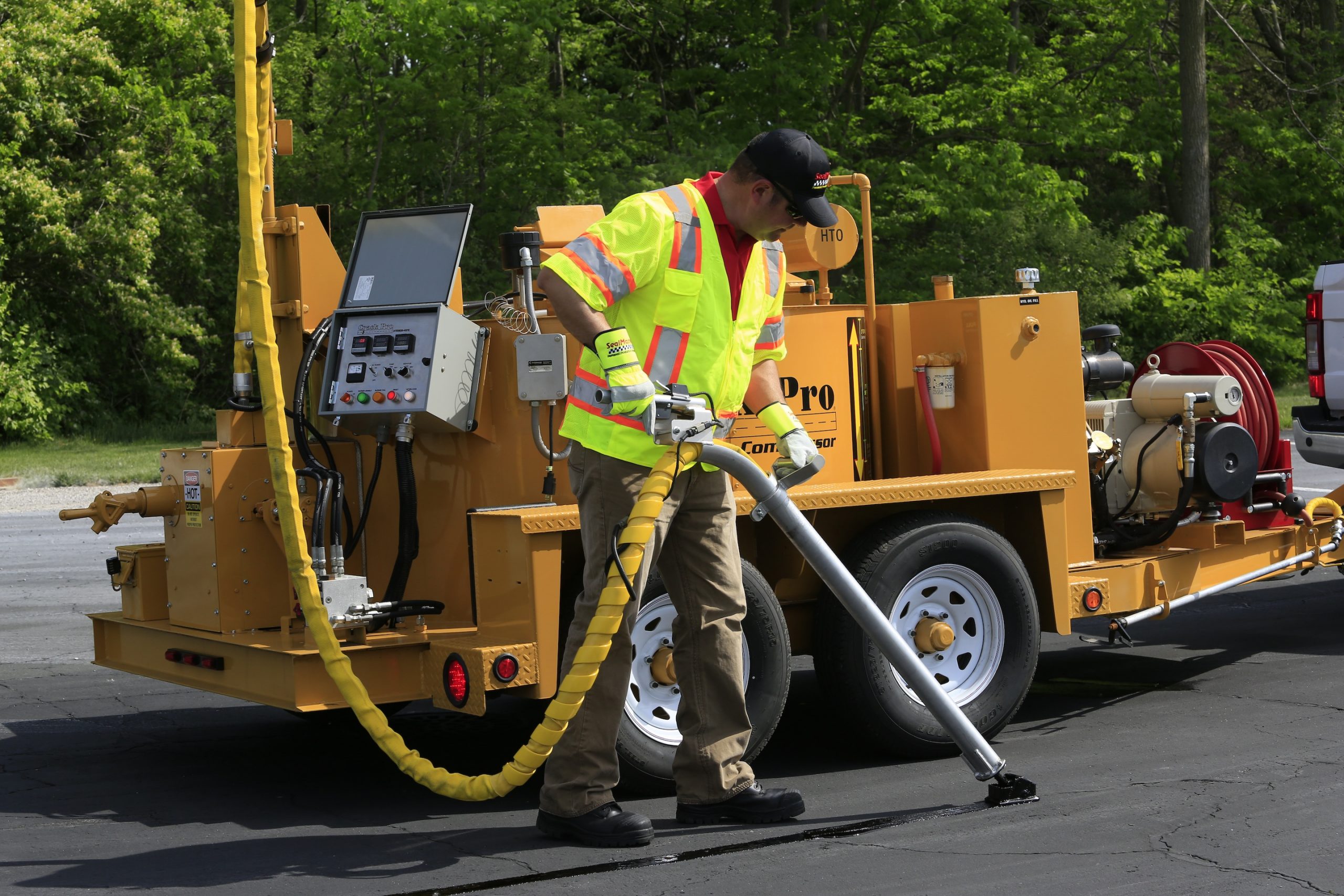
Hot-applied crack filling involves heating rubberized asphalt crack sealants and applying the molten material into pavement cracks. Hot-pour crack filling and sealing is commonly performed on roads and highways where durability and flexibility are essential.
Hot rubberized crack sealants are blends of asphalt and polymers that are heated to approximately 400 degrees in specialized melting equipment. The material is supplied in solid blocks that are melted and applied while hot. Once applied, the material cools quickly and often allows traffic to return in 10 minutes or less.
Direct Fire Melters
Direct fire melters heat crack filling material directly over a burner and are commonly used for moderate volume crack filling operations.
Direct Fire Melters are commonly used for:
- Smaller crews
- Moderate production requirements
- Jobs where portability is important
Key Features to Consider
- Tank capacity and melting rate
- Manual or hydraulic agitation
- Burner type and temperature controls
- Safety shut-offs and insulation
Direct fire melters offer simplicity and mobility but require careful temperature management to prevent material overheating.
SealMaster Direct Fire Melters
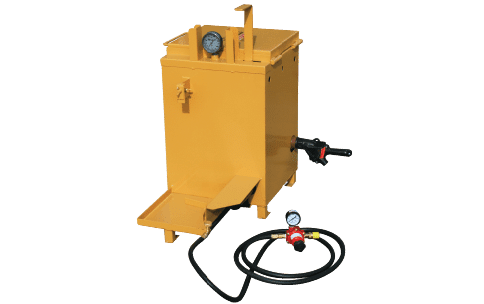
SealMaster direct fire crack filling melters are designed for contractors and maintenance crews performing moderate volume hot-applied crack filling. These machines heat rubberized crack sealant directly over a burner and are valued for their portability, simplicity and fast heat-up times.
Direct fire melters are commonly used for smaller jobs, localized repairs and operations where mobility and quick setup are important.
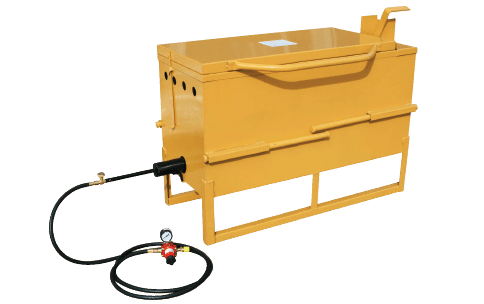
SM-30 Direct Fire Melter
The SM-30 Direct Fire Melter is a mid-size unit designed for contractors who need increased material capacity without sacrificing portability. Its straightforward design allows crews to melt and apply crack sealant efficiently on a wide range of pavement maintenance projects.
Best suited for:
Small to mid-size crack filling jobs requiring greater capacity than portable units.
Key features include:
- 30-gallon material capacity
- Burner with hose and regulator
- Hand-operated agitator
- Retractable carrying handles
- Approximate melt time of 30 minutes
MA-10 Melter Applicator
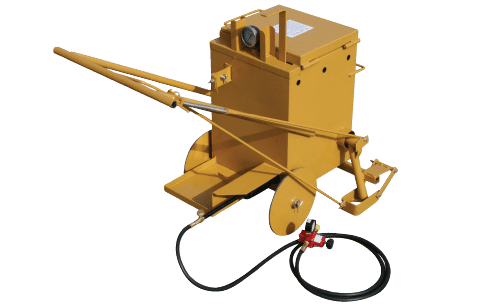
The MA-10 Melter Applicator is a compact, portable unit designed for light-duty crack filling applications. Its fast melt time makes it well-suited for quick repairs and smaller maintenance jobs.
Best suited for:
Spot repairs, small maintenance projects and areas with limited access.
Key features include:
- 10-gallon material capacity
- Burner with hose and regulator
- Hand-operated agitator
- Melt time of less than 30 minutes
SM-10 Melter
The SM-10 Melter is a simple, entry-level direct fire unit designed for moderate volume crack filling applications. Its compact size allows for easy transport and use in confined areas.
Best suited for:
Moderate volume crack filling and contractors needing a lightweight, portable solution.
Key features include:
- 10-gallon tank size
- Burner with hose and regulator
- Straightforward operation for basic crack filling needs
Oil-Jacketed Melter Applicators
Oil-jacketed melter applicators use heat transfer oil to evenly heat crack filling material throughout the tank. This design provides consistent material temperature, faster recovery times and improved application quality.
Oil-jacketed equipment is commonly used for:
- High-production crack filling
- Pavements with working cracks
- Larger contractor crews
Key Features to Consider
- Heated hose systems for consistent material temperature
- Automatic temperature monitoring and controls
- High-torque agitation systems
- Pump-assisted or gravity flow application
Oil-jacketed machines are ideal for contractors seeking maximum productivity, material performance and operator safety.
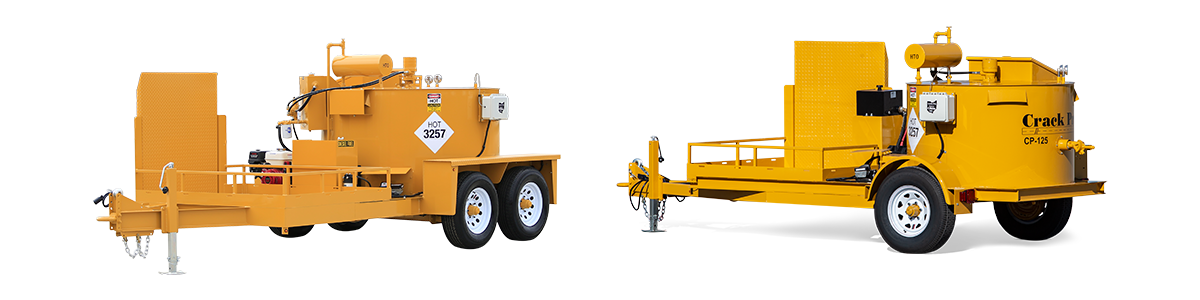
SealMaster CrackPro 125 and 260 Gravity Flow Melters
SealMaster CrackPro 125 and 260 Gravity Flow Melters are designed for hot-applied crack filling operations that require fast heat-up times and simple, efficient material application. These machines rely on gravity flow rather than pump-assisted delivery, allowing material to flow directly into a pour pot for controlled placement.
CrackPro Gravity Flow Melters are built for productivity, with materials ready to apply in approximately one hour and a counter-balanced pour pot design that reduces operator fatigue during application.
Best suited for:
Hot-applied crack filling operations where simplicity, speed and operator control are priorities.
Key features include:
- Fast heat-up time with material ready for application within approximately one hour
- State-of-the-art burner system with automatic shut-off
- Forward and reverse hydraulic agitation
- Direct-drive hydraulic agitation system
- Anti-splash material loading hatch for safer operation
- Oil and material temperature gauges
- Automatic temperature control
- Low-profile design to enhance operator safety
Optional feature:
- Extended deck for added workspace and material handling flexibility
SealMaster CrackPro Oil-Jacketed Heated Hose Machines
SealMaster CrackPro oil-jacketed melter applicator machines set the industry standard for high-production hot rubberized asphalt crack filling and sealing. These machines are designed to melt and apply hot-applied crack sealants for asphalt and concrete pavements while maintaining precise temperature control throughout the application process.
CrackPro oil-jacketed units are available in multiple sizes and configurations, including gravity flow machines and melter applicators equipped with pump systems and heated hose. These machines are commonly used by professional contractors performing large volumes of crack filling and sealing.
Standard Features on All CrackPro Heated Hose Machines
All SealMaster CrackPro heated hose machines share a common set of performance and safety features designed to support consistent material application and operator control, including:
- Heated hose system that maintains material temperature through application and includes a lightweight aluminum wand with crack sealing shoe
- Fast heat-up and recovery with material ready for application in approximately one hour
- Waterproof steel control cabinet housing safety interlocks and system monitoring for hose, material and heat transfer oil
- Anti-splash material loading hatch for safer operation
- Insulated tank with 1.5-inch ceramic insulation and 14-gauge steel outer body
- Electro-hydraulic manifold with flow control for pump and mixer speeds
- Liquid-cooled Kubota diesel engine
- Diesel-fired burners with electronic control and automatic shut-off
- Wand-mounted horn button for driver forward and reverse communication
- Direct-drive forward and reverse full sweep agitation
CrackPro Oil-Jacketed Heated Hose Melter Applicators
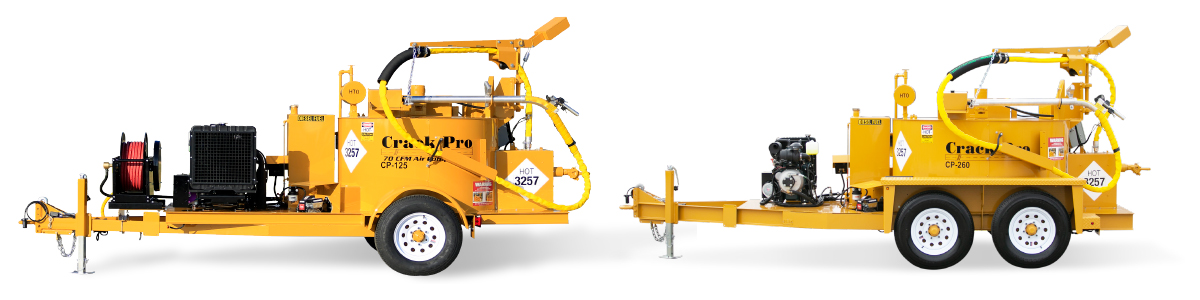
CrackPro oil-jacketed heated hose machines are designed for contractors who require maximum productivity, consistent material temperature and precise application control. These machines are well-suited for crack filling and sealing of working cracks on high-traffic pavements. These machines are available in 125 and 260-gallon capacities.
Best suited for:
High-production crack filling and sealing operations on roads, highways and large parking facilities.
Key advantages include:
- Consistent material temperature from tank to wand
- Reduced risk of material scorching
- Improved application control and productivity
- Enhanced operator safety and ease of use
TR 125 and TR 260 Double Pump DA Models
For contractors with higher production demands, CrackPro TR 125 and TR 260 double pump DA models are available. These machines are equipped to support continuous application and increased material output.
Best suited for:
Large-scale crack filling and sealing projects requiring sustained production
Key features include:
- Double pump configuration for increased output
- Direct-drive air compressor
- 100-ft by 5/8-inch reeled hose and wand system
Mastic Equipment
Mastic equipment is designed for heating and applying rubberized asphalt mastic materials that contain aggregate. These machines are used when cracks are too wide or pavement distress is too severe for standard crack filling methods.
Mastic Equipment is commonly used for:
- Wide cracks and longitudinal joints
- Alligatored and distressed pavement
- Utility cuts, potholes and localized patching
- Leveling uneven pavement surfaces and faulted areas
Key Features to Consider
- Oil-jacketed heating systems
- High-torque agitation and forced discharge
- Heavy-duty discharge valves and chutes
- Integrated tool heaters and pail warmers
Mastic equipment provides structural reinforcement and long-lasting repairs in high-stress pavement areas where traditional crack filling isn’t sufficient.
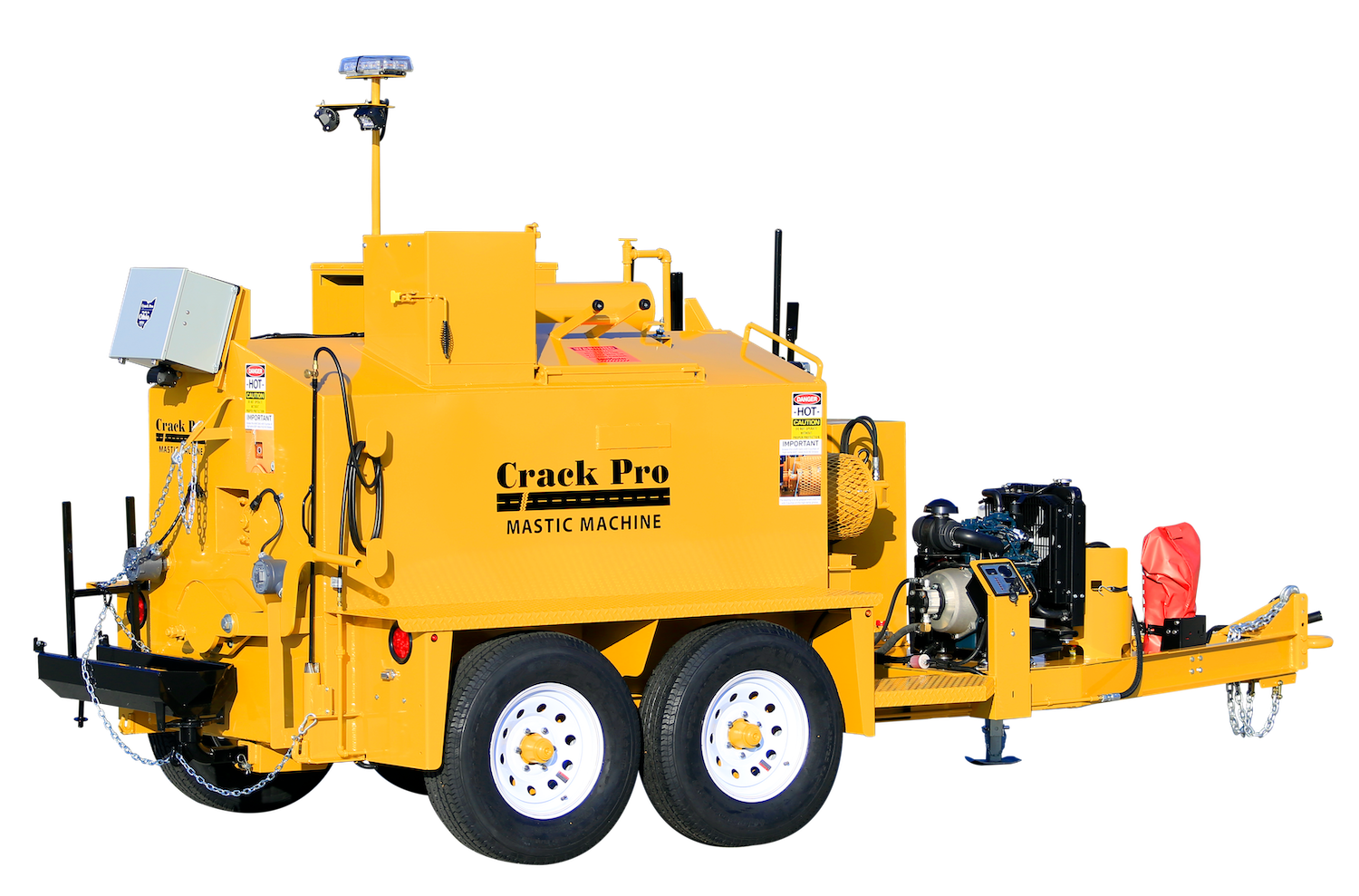
SealMaster Crack Pro Mastic Machine
The SealMaster Crack Pro mastic machine is an all-diesel, oil-jacketed melter applicator engineered for applying hot rubberized asphalt mastic in structural pavement repair applications where standard crack filling methods are not effective. The machine is available in a 300-gallon capacity.
Mastic equipment is commonly used for repairs involving wide cracks, distressed pavement and areas requiring aggregate-filled material to restore pavement structure and surface integrity.
Best suited for:
Structural asphalt repairs using hot-applied mastic material.
Common applications include:
- Wide transverse and longitudinal cracks and joints
- Alligatored and distressed pavement
- Utility cuts and potholes
- Localized patch repairs and leveling
- Bridge approaches and faulted pavement areas
Key features include:
- All-diesel engine and heating system with no propane required
- Oil-jacketed kettle with an approximate 2.5-hour heat-up time from a cold start
- Plow-point agitation with forced material discharge
- High-torque agitation system with safety interlocks
- Heavy-duty 6-inch adjustable knife discharge valve designed to cut through mastic aggregate
- Heated discharge chute that remains hot without propane and can be removed for use with wheeled or hand-held applicators
- Integrated pail warmer and large tool heater box with automatic shut-off
- Waterproof steel control cabinet housing the Crack Pro control system
- Forward and reverse agitation control
- Work lights and strobe lights for improved jobsite visibility
- Adjustable pintle eye and tandem axle for stable towing
- 30-gallon fuel tank providing approximately 15 to 25 hours of operation
- Easy-access service points for routine maintenance
Choosing Crack Filling Equipment for Your Next Project
Choosing crack filling equipment should be guided by pavement conditions, material requirements and long-term performance goals rather than price alone. Equipment that supports proper material placement, temperature control and productivity helps deliver consistent results and long-lasting repairs.
Reminders to consider:
Material handling and temperature control play a major role in equipment selection since some crack fillers are applied at ambient temperatures while others must be heated and held within a specific range during application. Equipment should be selected based on how the material is heated, maintained and delivered into the crack.
Production needs and job size should guide decisions on tank capacity, heating system and application method with smaller projects often handled by portable units or direct fire melters. Larger jobs and higher daily production volumes typically require oil-jacketed machines, heated hose systems or distributor units designed for continuous application.
Weather conditions and time of year affect both material performance and equipment choice, as cold-applied materials generally require warmer temperatures, while hot-applied crack sealants can be installed in cooler conditions. Equipment that maintains consistent material temperature helps crews work efficiently and extend the application season.
Safety, efficiency and long-term value are influenced by features such as insulated tanks, automatic temperature controls and safety interlocks that support consistent application and protect operators. Efficient equipment helps reduce labor demands and lower the overall cost per linear foot over time.
Selecting equipment that aligns with these factors helps contractors deliver higher quality repairs, extend pavement life and improve overall return on investment.
Learn More About Selecting the Right Equipment
Crack filling is one part of a successful pavement maintenance preservation program and equipment selection plays a critical role in long-term efficiency and growth. As contractors expand services, the ability to pair crack filling equipment with the right sealcoating systems helps improve productivity, reduce labor costs and deliver consistent results across a wide range of projects.
To better understand how crack filling fits into a complete pavement maintenance program, explore our guide on selecting sealcoating equipment for long-term growth. This article explains how different sealcoating machines, tank sizes and application methods support business scalability and how coordinating equipment choices can help contractors build a more profitable, sustainable operation.
Read next: Selecting Sealcoating Equipment for Long-Term Growth
SealMaster Expertise and Support
With more than 60 years of industry experience and more than 3 billion gallons of pavement sealer applied worldwide, SealMaster is recognized as the No. 1 brand of pavement sealer. As a one-stop source for pavement maintenance solutions, SealMaster offers premium products, sealcoating equipment and training through a franchise network of 125+ manufacturing and distribution centers across North America, along with product distribution in more than 60 nations.
This extensive reach ensures contractors, municipalities and property owners get the support they need to maintain and extend the life of their pavement. SealMaster’s national network of professional contractors provides full-service pavement maintenance solutions including pothole repair, crack filling, sealcoating and line striping.
For expert guidance, product recommendations or to connect with a pavement maintenance specialist, contact your local SealMaster for a free inspection or project estimate.